

Every solar site tells a different story—and some challenge conventional thinking more than
others.
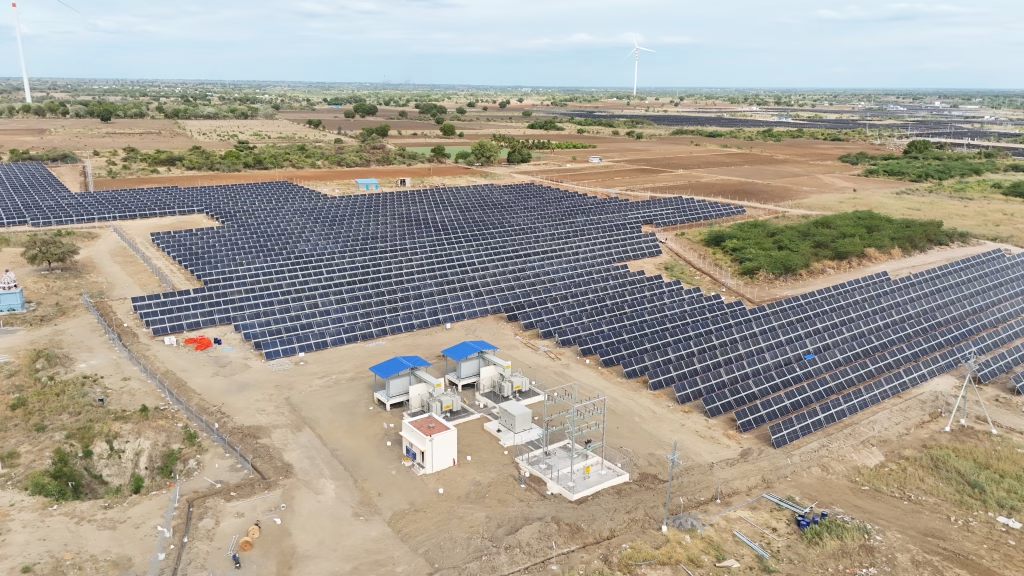
This project in Tamil Nadu began when one of our partners approached us with plans for a 13
MWp fixed-tilt solar installation. At first glance, the design looked solid. But once we took a
deeper dive into the site conditions, land geometry, and long-term performance goals, it became
clear that there was an opportunity to do better.
After detailed analysis, we proposed an alternative: switching from fixed-tilt to the
SolarGik tracking system.
– What followed surprised even seasoned solar professionals.
– System capacity reduced from 13 MWp to 11 MWp — an 18% drop
– Projected energy generation increased by 0.3%
– Overall project CAPEX reduced by ~5%, even after including tracker technology
– Fewer modules meant less cabling, lighter structural requirements, reduced groundwork, and a
more efficient use of materials—all contributing to lower costs and higher performance.
The Real Game-Changer: The Site
The land itself was the biggest constraint—and the biggest opportunity.
The site had an irregular, non-uniform shape, making it unsuitable for conventional tracker
systems at this scale. In many cases, such terrain forces developers to compromise on layout
efficiency or revert to fixed-tilt designs.
This is where SolarGik Trackers truly stood out.
Thanks to its compact table design (8–24 panels per table), the tracking system could be
configured almost like puzzle pieces, fitting seamlessly into the site’s unique geometry. The
system offered the layout flexibility of fixed-tilt combined with the generation advantage of
tracking, maximizing power density without sacrificing installability.
The results spoke for themselves.
Impressed by the performance gains and site adaptability, our partner has now added an
additional 1 MW of DC capacity, further optimizing output during peak generation hours and
extracting even more value from the same land parcel.
This project is a powerful reminder that bigger isn’t always better—and that smart technology,
thoughtful design, and site-specific solutions can unlock superior results.
With the right approach, it’s possible to:
– Generate more energy with less capacity
– Reduce costs while improving performance
– Turn challenging land into a high-value solar asset
technologies—and this project in Tamil Nadu is a perfect example of that philosophy in action.